Showing posts with label Peach Tree. Show all posts

Friday, October 19, 2012

No Longer Stumped

Back in July I had a couple trees cut down but I wasn’t able to have the stump of my peach tree professionally ground because the machines were too big to fit within the confines of the brick that makes up the raised bed.  So I have been slowing digging it out by means of my own two hands.  Or, rather, by means of my own sore arms, an aching back and two wobbly legs. 

The peach tree gave us privacy but not peaches.  It was time for it to go.
As I mentioned in my last post (in which I whined at length about the lingering heat) it’s been really hot here for a long time.  Swinging a 5-pound mattock is hard work even in perfect weather.  When it’s a hundred degrees it just feels like punishment.  So I tackled the removal of the stump in small doses.  Sometimes I’d get out there during my lunch hour and swing an ax or pry with a shovel for 20 minutes and then retire.  When I managed to get out there early on a weekend morning I was able to work long enough to make blisters on my hands in pleasing shades of red and yellow.  But most of the time I would just go out there and stare at it, hatefully, so that it knew it was no longer welcome.

While I worked, I filled a 5-gallon bucket with the mashed up pieces of wood.  I lost track of how many times I emptied that bucket but it was more than I would ever have imagined.  When you start digging up stumps and roots you realize that a tree cut off at ground level is just like an iceberg or a character in a John Hughes film.  The substance below the surface dwarfs what you see initially.

I originally thought that this was a beautiful piece of wood cut from the top of the stump of the peach tree.
Now I know it was just the tip of the peach tree iceberg.
But since I last wrote, we have had a few days that weren’t punishingly hot and I’ve been able to expand the amount of time I was willing to work on my one-man chain gang.  And I finally finished about a week ago.  Of course, I use the term "finished" loosely.  There's still some wood buried deep down but, honestly, I didn't care anymore.  I think I removed enough that it won't be a real issue even when the wood starts to rot and the earth settles in around it.   

One of the greatest gardening joys is day-dreaming about what you want to plant when you have a clean slate.  This is especially true when space is limited and your garden plot is not resting upon a supernatural Etch-a-Sketch that can be shaken whenever things go awry or boredom with the status quo takes over.  Such has been my joy for the last two months.

This was my day-dreamer's checklist of requirements for whatever I would plant in place of the peach tree:
  • Had to take partial to full sun.
  • Had to be big enough to provide screening from the neighbor's windows.
  • Couldn't be so big that it impeded the nearby path.
  • Needed to be a good transition from the full sun part of the yard to mostly shade part of my yard.
  • I wanted it to look clean and be low-maintenance.
I considered an apple tree but decided against it because I didn’t want to deal with protecting it from worms or moths or whatever pests might attack it -- not low maintenance.  I considered planting an orange tree that I have had in a pot for several years but decided against it because I like it where it is -- besides, I thought it might get too big without constant pruning.  I considered a chaste tree and even bought one but it failed to meet the screening criteria.  I also considered a clumping bamboo called ‘Alphonse Karr’ but decided against it because even clumping bamboos should be watched carefully when planted in the ground. 

Chaste Tree bloom - in October!

I finally decided that I would, once again, ignore the advice of the experts and plant yet another Japanese maple in a full-sun location because I like them more than any other tree or plant.  And it didn’t hurt that the garden center was running a 20% off sale on all “fall color trees”.  I went with a 15-gallon Acer palmatum var. dissectum ‘Seiryu’.  It’s a fairly common tree but with uncommon characteristics.  The phrase you’ll hear about it most often is that it’s “the only upright growing green dissectum.”  Translated, that means it’s the only green Japanese maple that looks like the archetypal tree and still has these really cool lacy leaves. 

Seiryu leaves.
It seems like every project leads to another project.  When I removed the
previousplants from this bed it highlighted the fact that the brickwork
needs some serious attention.

I am hoping to give myself and my neighbors some privacy by blocking the view of their windows.

I under-planted the tree with 10 clumps of Japanese Blood Grass (Imperata cylindrica Rubra).  I don’t think it will take too long for it to take over the entire bed.  Perhaps a year or two.  I could have purchased more, but at $6 bucks each, it would have cost a pretty penny to fill in the entire bed.  Besides, Japanese Blood Grass spreads fairly quickly and it can be divided easily. 


Now I suppose I should work on that dead patch of lawn where the mulberry tree once grew.

Wednesday, July 25, 2012

Tiiiiimmmmbbbbeeerrrrr

Once upon a time I took a Lit test on a novel (Saint Maybe) of which I had read only the first 16 pages.  But I had gone to the 3-hour night class the week before and paid attention to the discussion so I felt reasonably certain that I would do well on the test.  And I did.  I received the highest grade in the class. 

Later that year I showed up to my 12:30 p.m. Modern Philosophy class after two weeks of having slept through classes and discovered that we were having a test that day.  I was so lost.  I received the lowest grade in the class.   The 35% I received was generous. 

Of course, this has absolutely nothing to do with gardening.  But I bring it up because it speaks to the way I do things.  I am equal parts slacker and over-achiever.  I am just as likely to procrastinate as I am to get something done immediately.  It just depends on my mood.  

Naturally, I take that approach to life into the garden. 

I took this photo on the night before the tree was scheduled to walk the un-Green Mile.
It's not a good photo because of the harsh lighting, but it lets you see what a dominate feature the tree was.  


My mood lately has been all about getting things done.  A couple weeks ago it occurred to me that I had a couple problem trees and after writing about it and getting some valued feedback I decided to get them chopped down.  And, as of yesterday, those trees are now mulch destined for someone else’s yard. 

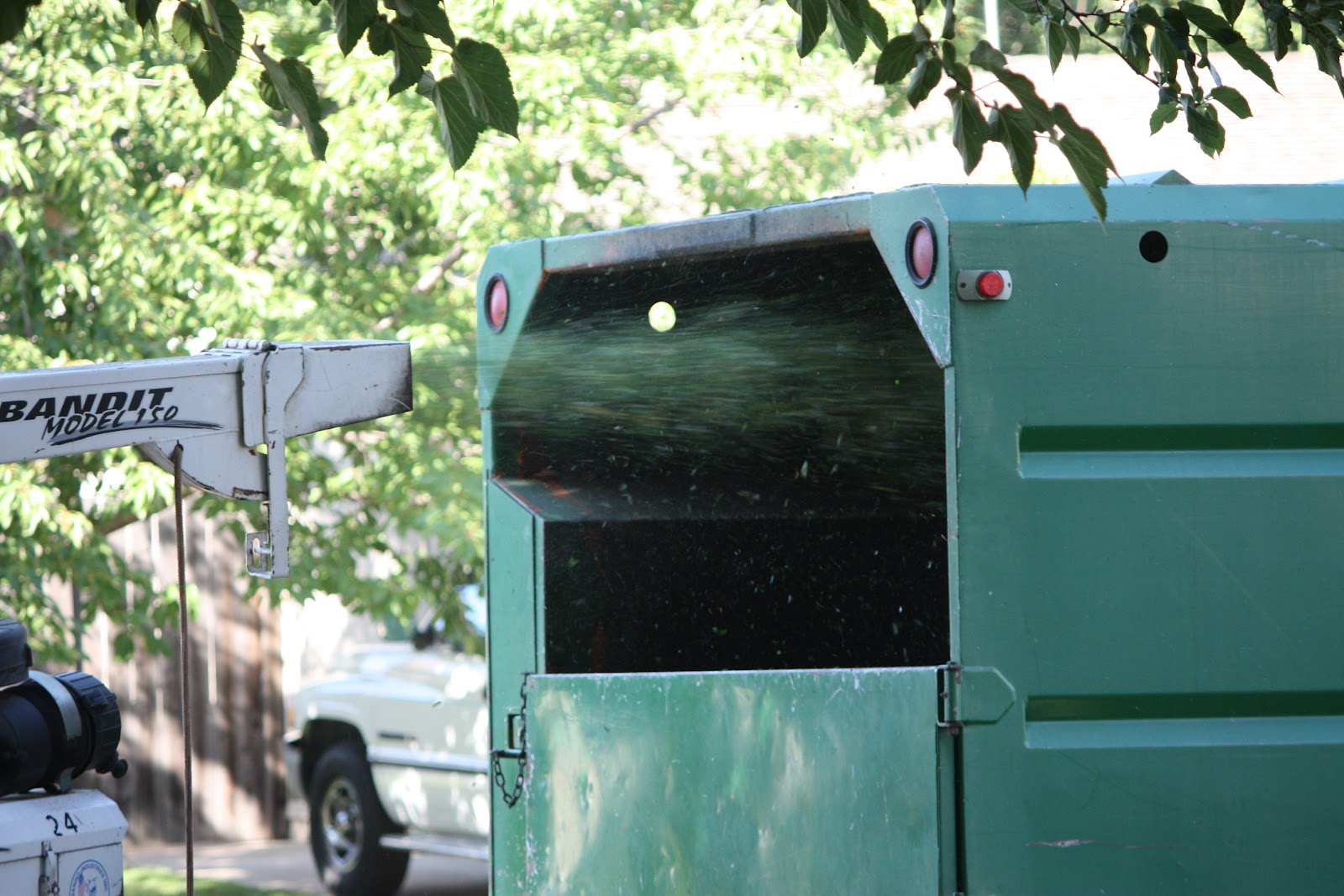
I can't see one of these in action without thinking of the movie "Fargo".


I was pretty proud of myself for taking action and getting things done so quickly. 

And then 5:00 rolled around – generally the hottest part of the day in Sacramento – and as I stood in the middle of my newly “full sun” lawn with a hose in hand, I found myself metaphorically kicking my own butt for acting so quickly.  I really should have waited until October to cut down the shade-giving mulberry tree.  Another couple months wouldn’t have made a big difference in my gardening plans anyway. 


As for the peach tree that was cut down I don’t have that same regret.  No, it’s an entirely different regret.  The arborist I hired told me he thought the reason it stopped producing peaches was because I let the tree get too tall and overgrown.  It had grown beyond its fruit-bearing size and could have benefitted from new wood every year.  Oops.

I wish I had kept this section of the peach tree but they took it before I got to it.


What’s done is done though, right?  It’s easy to look back on life and second guess the choices we made, to cling to regrets, to redden with shame for the things we did or didn’t do.  But once we’ve learned our lessons from those things, there’s really no use in holding onto them.  I have learned the value of reading every word of a book, I have come to see the truth in the saying “90% of life is just showing up”, and now I know the importance of planting the right tree in the right place and that sometimes it is okay to procrastinate when doing so gives you a little more time to enjoy the shade.

Sawdust and hydrangeas or what was and what still is.

Friday, July 13, 2012

You've got to Know the Rules Before You can Break Them

If you spend any time reading gardening blogs you’ve probably noticed that many of us are writing about how hot the weather has been and what that has done to our gardens.  Hot summers are not unusual for Sacramento, California at all.  If it’s July and it’s 95 degrees outside it’s barely worth mentioning.  But when it hits 105, like it has the past couple days, everyone starts talking about the weather again – not just gardeners.

My garden has not come through unscathed.  Hit hardest have been the calla lilies I planted in the wettest spot in my garden and my two newest "planted" Japanese maples. (I put most of them in pots in protected areas.)

That the calla lilies have suffered was a surprise to me as they were purposely placed in the one spot in my yard that is consistently wet and nothing else I have would grow there because of it.  So it must be hot and dry if the lowest, wettest part of my yard that typically gets standing puddles after watering is bone dry.

I already cut out the brownest of the foliage.
I chose two Japanese maple cultivars that are said to be the most sun-tolerant to plant in a sunny bed at the far end of my back yard.  The thing about Japanese maples though, is that sun tolerance is relative.  The local gardening guru, Farmer Fred, is fond of saying “all gardening is local.”  I couldn’t agree more. 

Japanese maples are better suited for other climates like that of . . . Japan, for one.  And places like Portland, Oregon and Seattle, Washington.  Places that don't get too hot or too cold, that get a fair amount of rain but maybe not constant rain like we tend to imagine Seattle gets.  (I have friends that live in Seattle and although they admit that it might rain every day, it’s not rare for it to rain for half an hour and then be sunny and beautiful for a couple hours afterward.  At least in the summer time.) 

My 'Orangeola' back in April.  Still redish orange and still free of leaf burn.

Here in Sacramento you can certainly grow a Japanese maple but the near-universal advice newbies get on planting them is doubly true here: plant them where they can get morning sun and afternoon shade.  The morning sun helps the tree achieve or maintain the color or variegation it is known for.  Without the sun, even the reddest of maples can turn green in the summer. 

The afternoon shade is necessary to protect the tree from the hottest part of the day and that helps prevent leaf burn which can be harmful to the trees and it's really unsightly. 

That said, I knowingly planted the two victimized maples in a spot that gets morning shade and afternoon sun.  You’ve got to know the rules before you break them, right?  Well, I’m paying for my rebelliousness now and the currency is ugly leaves. Take a look:

'Orangeola' leaves today - fried to a crisp.

Fireglow leaves look as if they were too close an actual fire's glow.  

So why did I do it?  I did it because I know that every year that these trees are in the ground their root systems should develop more and, as a result, protect the tree better in these times of extreme heat.  I also did it because I have to trust that the crepe myrtle I planted in 2010 and the Arbutus Marina (Strawberry tree) I planted last year will, some year soon, be big enough to provide that all-important afternoon shade. 

And I just realized today that if I proceed with cutting down my peach tree it will provide just enough morning sun for the Japanese maples to be in the perfect spot. 
-----------------------------------------------------------------------------------------------------------------------------
P.S. After writing this blog post I went to check on these trees and they struck me as looking even more stressed than I thought they should. I turned on the sprinklers and, sure enough, they needed adjustment.  In addition to the extreme heat these poor trees were suffering from a lack of water.  Mea culpa!

Sunday, July 8, 2012

I Am My Garden's Biggest Pest, Apparently

Almost ten years ago my wife and I started looking for our first home.  It was a frustrating experience because it occurred right in the beginning of the housing boom in California.  Home prices were increasing on a weekly basis and even though we were offering more than the asking price we were getting outbid.  Our poor agent (who deserves nomination for sainthood) wrote something like 25 offers on houses for us.  At the time she said it was the most she’d ever had to write for a client. 

Depressed by our lack of success, we started grumbling about giving up and finding an apartment to rent.  But before we got carried away with our Plan B we decided to spend one more weekend checking out open houses.  And that is when we discovered our house.  I was immediately enchanted.  Although I was not yet a gardener, I had grown up under the shadows of trees.  And this house had trees. 

Well, it had six trees anyway.  In the front was a giant fruitless mulberry tree which cast a luxurious canopy of shade on the front of the house.


As I walked up to the front door that first time I remember the feeling of comfort that shade provided.  It felt almost like I had wandered into a forest.  In the back yard there were 3 aspen trees (or were they birch trees? I had no idea), some kind of palm tree, and a white peach tree.  I hated the palm immediately and never changed my opinion.  

This is what the corner garden looked like when we moved in.  
I loved the others.  It felt like home so we made an overly generous offer and, miracle of miracles, it was accepted.

A decade later there are now about 30 trees on my property.  The Aspen/Birch trees didn’t make it.  They were planted in the lawn and the grass grew right up to the trunks.  I don’t think the roots ever had a chance to get established so that first winter the trees bent to 45 degree angles after a few rain storms and some wind.  I tried propping them up and staking them but it was clear that they were the wrong trees in the wrong spaces.  The hated palm tree eventually started rotting.  I imagine it knew I didn’t care for it and decided to make it easy on me.  I spent a weekend cutting it down and digging out its roots.  There was never any manual labor I enjoyed more.    

Of the original 6 trees, only the Mulberry and Peach tree remain.  But I’m seriously considering changing that.  I will miss the size of the Mulberry tree but you know what I won’t miss?  I won’t miss the leaves clogging the gutters.  I won’t miss the roots coming to the surface and ruining everything in its wake.  I won’t miss how the roots occasionally crush the PVP sprinkler pipes.  And I won’t miss the annual bill for having the branches trimmed back.  Left to its own devices, the branches quickly grow to the point of touching our roof and extending over the neighbor’s yard.  The other day I watched from the window as the garbage truck lifted our can to dump it in only to have the can whack a bunch of gangly branches on the way up.  It’s only a matter of time before the county sends me a form letter saying they won’t pick up our trash unless we do something about that tree.  I will feel bad about seeing the tree go, but I think a smaller tree will eventually provide the kind of shade I first fell in love with without the unruly roots and annual costs associated with maintenance. 

As bad as I feel about the Mulberry, I feel terrible about the peach tree.  It’s not a tree I would choose to get rid of and the fact that I’m now faced with that possibility is an indictment on my early days as a homeowner.  The peach tree originally was a multi-stemmed specimen.  Someone once told me that trees only have one trunk.  So, I guess the correct way to say this is that there was one trunk but three main stems.

Here is the peach tree from "back in the day."  

Initially the tree gave us buckets and buckets of peaches.  For years I would spend a few minutes each August night picking up the fallen peaches before the ants and rodents could get to them.  It wasn’t uncommon to fill up an entire 5-gallon Homer Bucket.  There was so much fruit and I was so thrilled.  I never once considered that there could be too much fruit. 

Not this kind of Homer Bucket

This kind of Homer bucket!

Until it was too late.  The first stem cracked under the weight of its own bounty about five years ago. The crack was probably seven feet long and several inches deep.  At first I thought it would heal on its own but the leaves quickly browned and it was clear that the stem/trunk would need emergency surgery.  So I cut it off at the base.  Sometime later a similar fate happened to the second stem.  Now the tree looks like a traditional tree with just one trunk.  I have spent a lot of time trimming out dead branches trying to improve air circulation and feeding it compost.  It’s the least I can do, right?  I would also be very careful about removing some of the fruit to keep the weight down if only there were fruits to remove.  I harvested a grand total of zero peaches last year.  I figured it was due to the really bad case of peach leaf curl that all of Northern California succumbed to last year.  But here it is late June of the next year and it doesn’t look like there will be anything to harvest this year either.  

Last night I spent some time inspecting the tree to see if there was any hidden fruit.  I couldn’t find any but I did find some hidden problems.  Most notably, I found a couple holes which appear to have been made by insects.  Termites?  Carpenter ants?  I really don’t have a clue but I can’t imagine that this is a good sign.


And then I found this huge fungus growing at the base of the tree where the other stems had been cut off.  Clearly, there is rotting wood here providing this fungus with a steady diet.


I thought about calling in an arborist but then I thought it might be pointless.  The tree seems beyond hope now and that makes me want to kick rocks sullenly.  Ten years after moving into this house and I’ve gotten to the point where I’m about to either kill or remove all the trees I inherited.  That seems wrong to me.

What feels right to me, however, is the thought of picking new trees to take the place of those trees that will soon provide us with the fuel for S’mores. 

Thursday, March 15, 2012

Monomaniacal

Last month I mentioned that I was reading “Moby Dick” and I tried to draw a comparison between Captain Ahab’s desire to seek out and kill the white whale that had maliciously devoured his leg and my personal issues with the grey squirrels that maliciously devour my seeds.    

Common flowers? Yes.  But colorful? Aye!


Well, I have now finished Moby Dick (finally) and in so doing, my head has been filled with a couple things: a nearly-encyclopedic and worthless knowledge of the anatomy of a sperm whale and a new lexicon of nautical and American romantic terms like “avast”,“hast”, and “doubloon.”  But the word that really got stuck in the riggings of my mind is “monomaniacal”.  It was the one adjective that Melville used to describe Ahab.      

My new Acer palmatum 'Murasaki Kiyohime' under
planted with dwarf mondo grass and a fern. 
The fern might have to be removed if it gets much bigger.

Now, monomaniacal is not a word you hear every day but it’s pretty easy to figure out what it means.  We don’t hear it every day because it is “no longer in technical use” as a way to describe a “psychosis characterized by thoughts confined to one idea or group of ideas.”

Close up of the Murasaki Kiyohime's spring leaves.  It's a dainty dwarf that does not take afternoon sun at all.

These days we probably just hear the word “obsessed.”  Obsessed is fine, but monomaniacal is more fun to say out loud.  Go ahead and say it. 

I’ll wait.  See?

Mexican Feather Grass, or Stipa tenuissima if you speak botanical.

Anyhow, given that it has been raining here in Sacramento all week and the gutters are filling up like it was the fourth day of Noah’s flood, a little fun is what I needed since I have not been able to do anything related to my monomaniacal desire to putter around the garden.    

The peach blossoms are getting ready to paddle off into memory.
I don't have a lot of pinks or reds in the yard.  These blossoms always make me second guess that decision.

Until today.  There was a brief reprieve in the typhoon this afternoon, okay, it's really just a light rain, so I went out and took these pictures in my back yard.  It might just have been enough to tide me over (nautical pun intended) until the next time the sun breaks through.  And when it does, I might have to fight back the urge to hail the sun with a hearty “Thar she glows!”  

I'm leaving the bird feeder empty for now.  It attracts too many of those damn squirrels.
Same picture but with a different focal point.

If you hate bad puns, I’m very very sorry for this post.  Please don’t make me walk the plank.    

I purchased these columbines this weekend.  I've never grown them before.