Wednesday, July 25, 2012

Tiiiiimmmmbbbbeeerrrrr

Once upon a time I took a Lit test on a novel (Saint Maybe) of which I had read only the first 16 pages.  But I had gone to the 3-hour night class the week before and paid attention to the discussion so I felt reasonably certain that I would do well on the test.  And I did.  I received the highest grade in the class. 

Later that year I showed up to my 12:30 p.m. Modern Philosophy class after two weeks of having slept through classes and discovered that we were having a test that day.  I was so lost.  I received the lowest grade in the class.   The 35% I received was generous. 

Of course, this has absolutely nothing to do with gardening.  But I bring it up because it speaks to the way I do things.  I am equal parts slacker and over-achiever.  I am just as likely to procrastinate as I am to get something done immediately.  It just depends on my mood.  

Naturally, I take that approach to life into the garden. 

I took this photo on the night before the tree was scheduled to walk the un-Green Mile.
It's not a good photo because of the harsh lighting, but it lets you see what a dominate feature the tree was.  


My mood lately has been all about getting things done.  A couple weeks ago it occurred to me that I had a couple problem trees and after writing about it and getting some valued feedback I decided to get them chopped down.  And, as of yesterday, those trees are now mulch destined for someone else’s yard. 
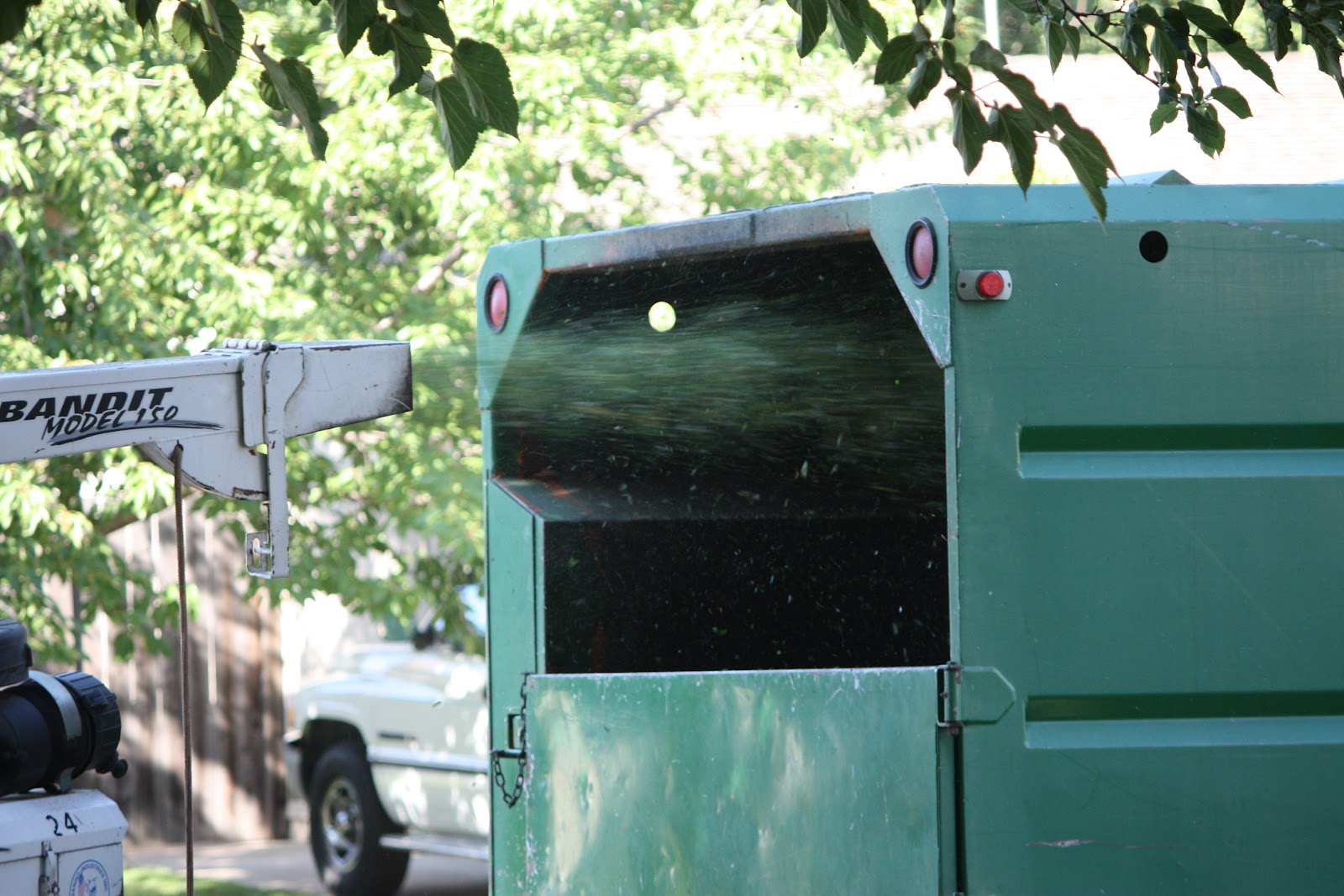
I can't see one of these in action without thinking of the movie "Fargo".


I was pretty proud of myself for taking action and getting things done so quickly. 

And then 5:00 rolled around – generally the hottest part of the day in Sacramento – and as I stood in the middle of my newly “full sun” lawn with a hose in hand, I found myself metaphorically kicking my own butt for acting so quickly.  I really should have waited until October to cut down the shade-giving mulberry tree.  Another couple months wouldn’t have made a big difference in my gardening plans anyway. 


As for the peach tree that was cut down I don’t have that same regret.  No, it’s an entirely different regret.  The arborist I hired told me he thought the reason it stopped producing peaches was because I let the tree get too tall and overgrown.  It had grown beyond its fruit-bearing size and could have benefitted from new wood every year.  Oops.

I wish I had kept this section of the peach tree but they took it before I got to it.


What’s done is done though, right?  It’s easy to look back on life and second guess the choices we made, to cling to regrets, to redden with shame for the things we did or didn’t do.  But once we’ve learned our lessons from those things, there’s really no use in holding onto them.  I have learned the value of reading every word of a book, I have come to see the truth in the saying “90% of life is just showing up”, and now I know the importance of planting the right tree in the right place and that sometimes it is okay to procrastinate when doing so gives you a little more time to enjoy the shade.

Sawdust and hydrangeas or what was and what still is.

Tuesday, July 17, 2012

Spreading It On Pretty Thick


I sift my compost into a large bucket and
I use a shovel to spread it on thick.
 Here’s a quick list of things I like to spread on pretty thick:

  • frosting
  • Nutella
  • cheese
  • sarcasm and
  • compost 
Unfortunately, only one of those things is really good for me though.  I could argue that sarcasm is good for me but as a college buddy used to say, “Sarcasm is the devil’s tool against intimacy.”  And I think he was serious.  Sometimes it’s hard to tell if someone is being sarcastic.

While I love frosting of all kinds on all kinds of things and Nutella is the spread of the Gods, I’m trying to keep my waistline in check.  So instead of slathering up a graham cracker with butter cream frosting yesterday I decided to remove myself from temptation and instead check on my compost. 

It’s mid-July so there’s not a lot for me to do in the garden except make sure things are watered and the sprinklers are all working; wage war on my weeds; deadhead flowers; pick strawberries, tomatoes, and zucchini; consult with arborists; battle more weeds, patch rusty gutters; mow and edge the lawn; knock down the spider webs around the front door; cast dirty looks at the neighbor that refuses to do anything with his weed farm; research new stepping stone options; and smell the roses.  When I said there wasn’t much to do in the garden, was I being sarcastic?  Pretty much everything I can do in the garden should be done this time of year except the most fun thing which is, of course, putting in new plants.  
 
My "Biostack" composter.  It's not pretty, but it comes in pieces that you can stack on top of each other.  I have
two of these so, in theory, my compost bin could be twice this tall but that would make turning it a real chore.
But is July the right time to spread compost? Is there a wrong time to spread compost? I’m sure there are better times to do it (like before you put down 2-4 inches of mulch in the spring) but my compost is mostly ready now and, believe it or not, it won’t be that long before autumn’s leaves start falling and I start filling up my Biostack composter. So I wanted to make some room now.

My compost bin is right next to a sitting area.  Soon the black bamboo in the wine barrel should do a better job screening it.
So if I can’t buy new plants the least I can do is treat the plants I do have with an indulgent snack of black gold.  Compost has to be the plant kingdom’s version of chocolate frosting only with more nutrients.

My composter is in plain sight throughout most of my "back garden" but I've tried to use plants to screen the view some.
 
Pulling back a few feet, it's hard to see the composter at all from this vantage point along the pathway.


Friday, July 13, 2012

You've got to Know the Rules Before You can Break Them

If you spend any time reading gardening blogs you’ve probably noticed that many of us are writing about how hot the weather has been and what that has done to our gardens.  Hot summers are not unusual for Sacramento, California at all.  If it’s July and it’s 95 degrees outside it’s barely worth mentioning.  But when it hits 105, like it has the past couple days, everyone starts talking about the weather again – not just gardeners.

My garden has not come through unscathed.  Hit hardest have been the calla lilies I planted in the wettest spot in my garden and my two newest "planted" Japanese maples. (I put most of them in pots in protected areas.)

That the calla lilies have suffered was a surprise to me as they were purposely placed in the one spot in my yard that is consistently wet and nothing else I have would grow there because of it.  So it must be hot and dry if the lowest, wettest part of my yard that typically gets standing puddles after watering is bone dry.

I already cut out the brownest of the foliage.
I chose two Japanese maple cultivars that are said to be the most sun-tolerant to plant in a sunny bed at the far end of my back yard.  The thing about Japanese maples though, is that sun tolerance is relative.  The local gardening guru, Farmer Fred, is fond of saying “all gardening is local.”  I couldn’t agree more. 

Japanese maples are better suited for other climates like that of . . . Japan, for one.  And places like Portland, Oregon and Seattle, Washington.  Places that don't get too hot or too cold, that get a fair amount of rain but maybe not constant rain like we tend to imagine Seattle gets.  (I have friends that live in Seattle and although they admit that it might rain every day, it’s not rare for it to rain for half an hour and then be sunny and beautiful for a couple hours afterward.  At least in the summer time.) 

My 'Orangeola' back in April.  Still redish orange and still free of leaf burn.

Here in Sacramento you can certainly grow a Japanese maple but the near-universal advice newbies get on planting them is doubly true here: plant them where they can get morning sun and afternoon shade.  The morning sun helps the tree achieve or maintain the color or variegation it is known for.  Without the sun, even the reddest of maples can turn green in the summer. 

The afternoon shade is necessary to protect the tree from the hottest part of the day and that helps prevent leaf burn which can be harmful to the trees and it's really unsightly. 

That said, I knowingly planted the two victimized maples in a spot that gets morning shade and afternoon sun.  You’ve got to know the rules before you break them, right?  Well, I’m paying for my rebelliousness now and the currency is ugly leaves. Take a look:

'Orangeola' leaves today - fried to a crisp.

Fireglow leaves look as if they were too close an actual fire's glow.  

So why did I do it?  I did it because I know that every year that these trees are in the ground their root systems should develop more and, as a result, protect the tree better in these times of extreme heat.  I also did it because I have to trust that the crepe myrtle I planted in 2010 and the Arbutus Marina (Strawberry tree) I planted last year will, some year soon, be big enough to provide that all-important afternoon shade. 

And I just realized today that if I proceed with cutting down my peach tree it will provide just enough morning sun for the Japanese maples to be in the perfect spot. 
-----------------------------------------------------------------------------------------------------------------------------
P.S. After writing this blog post I went to check on these trees and they struck me as looking even more stressed than I thought they should. I turned on the sprinklers and, sure enough, they needed adjustment.  In addition to the extreme heat these poor trees were suffering from a lack of water.  Mea culpa!